Murchison Gold Projects
Two Pools Gold Project
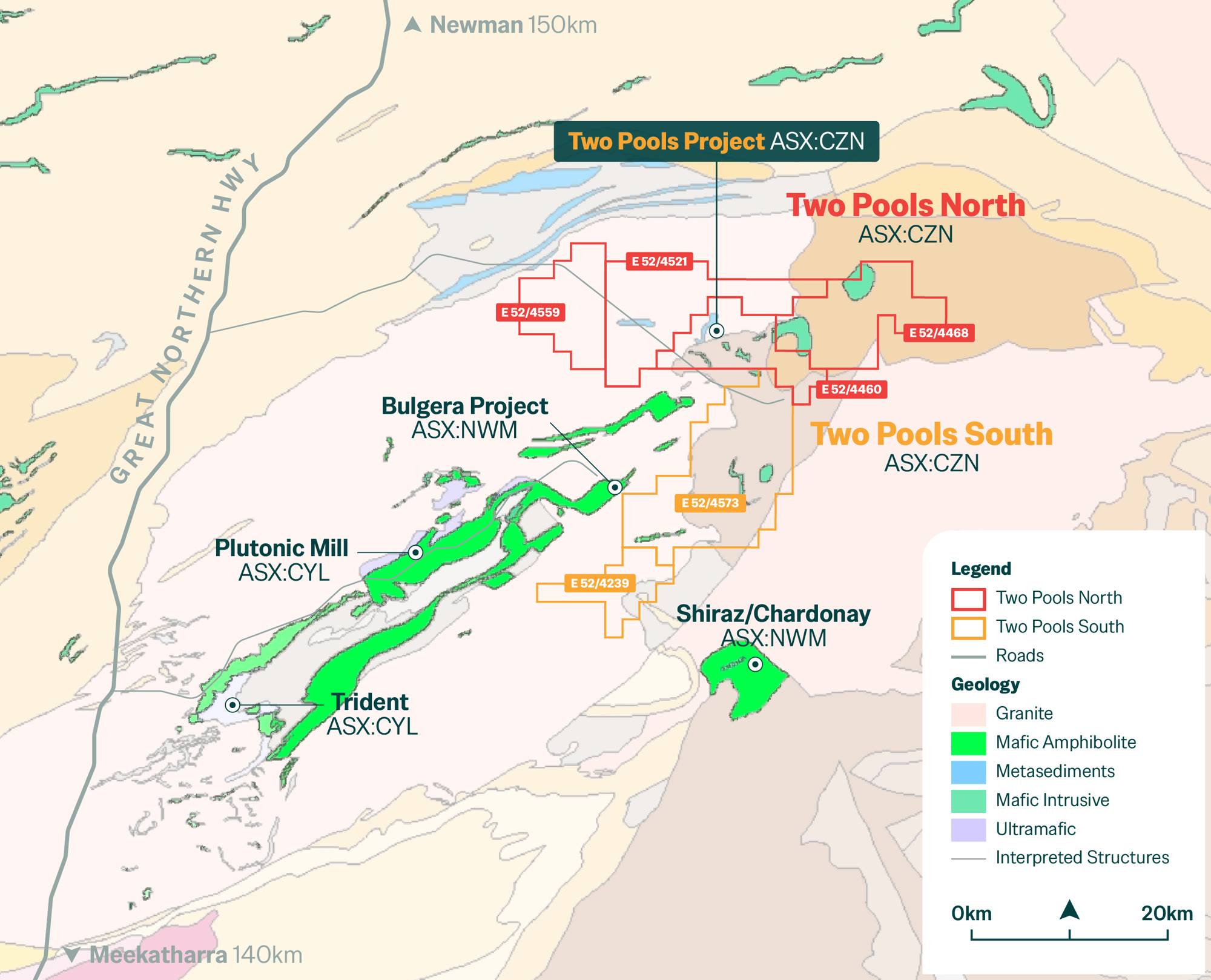
The Two Pools Gold Project covers 537km² within the Plutonic-Marymia Greenstone Belt in Western Australia’s Murchison region, approximately 60km from Catalyst Metals’ Plutonic processing plant. Corazon’s geological reinterpretation identified a previously unrecognised greenstone belt, 20km long and 3km to 6km wide, in ground that had been mapped as granite.
In August 2026, ten months after acquiring the project, Corazon defined a maiden Exploration Target of 1.4 to 2.15 million tonnes at 1.6 to 1.9 g/t Au, for 72,000 to 132,000 ounces of contained gold.
The potential quantity and grade of the Exploration Target is conceptual in nature. There has been insufficient exploration to estimate a Mineral Resource, and it is uncertain whether further exploration will result in the estimation of a Mineral Resource.
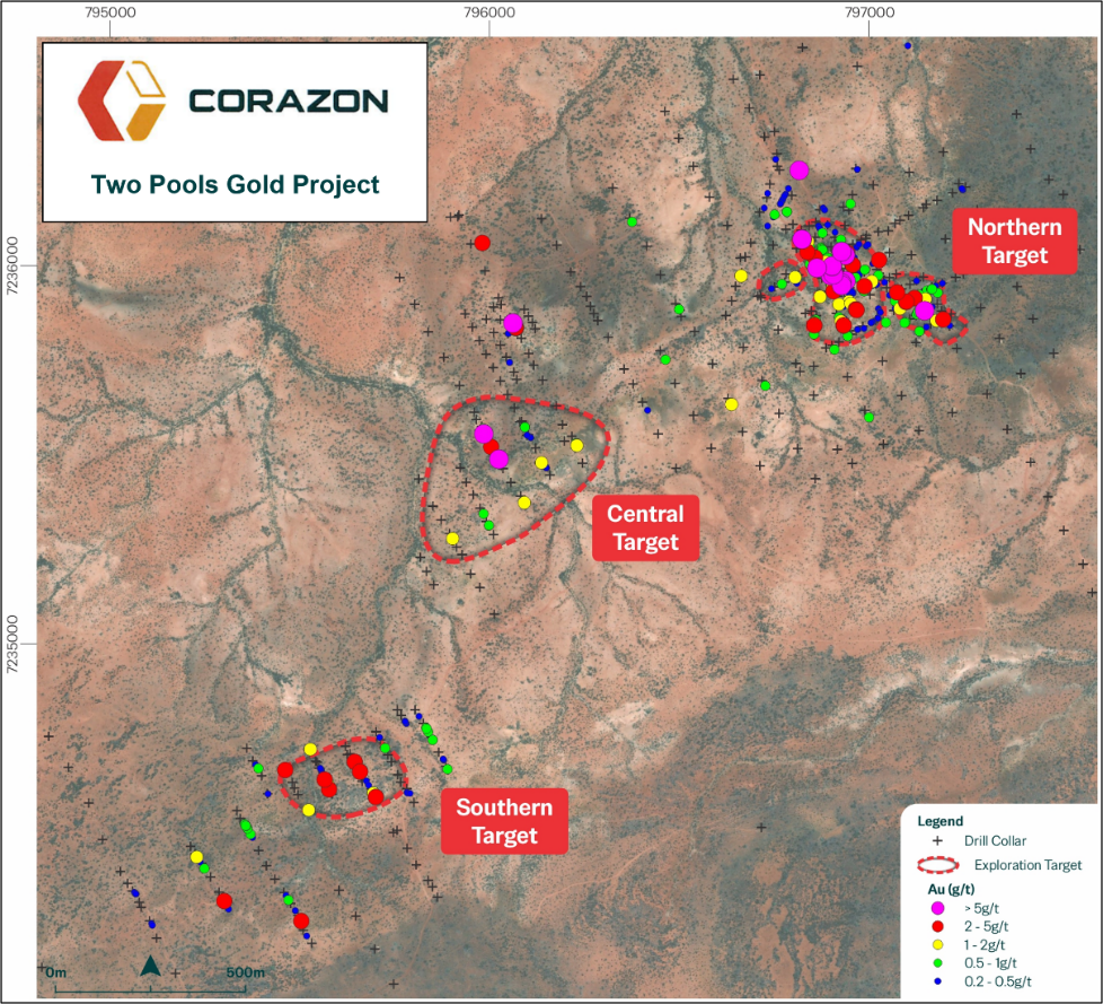
The Exploration Target is defined across three areas, Northern, Central and Southern, which together occupy a small fraction of the 20km greenstone belt. All three remain open along strike and at depth.
72,000 – 132,000oz Exploration Target
A maiden Exploration Target of 1.4 to 2.15Mt at 1.6 to 1.9 g/t Au, defined ten months after project acquisition across three target areas.
Conceptual in nature. Insufficient exploration to estimate a Mineral Resource. Uncertain whether further exploration will result in the estimation of a Mineral Resource.
A Belt Hidden in Plain Sight
Corazon’s reinterpretation identified a 20km long, 3km to 6km wide greenstone belt in ground previously mapped as granite. The Exploration Target covers only a small fraction of it.
Confirmed High-Grade Mineralisation
Historical drilling has delivered standout intercepts including 12m @ 8.90 g/t Au from 79m including 3m @ 34.25 g/t Au from 80m (MRC703), 18m @ 3.90 g/t Au from 83m including 4m @ 15.96 g/t Au from 95m (MRC693) and 8m @ 7.83 g/t Au from 66m including 1m @ 52.24 g/t Au from 69m (MRC701), with maiden diamond drilling in 2026 confirming a structurally controlled gold system in all four holes.
Substantial Under-Drilled Upside
The Northern target is defined by approximately 92 drill holes, with spacing as close as 15m to 30m in the better-drilled portions. The Central and Southern targets have drill spacing of up to 200m, leaving material scope for growth through infill drilling.
Exploration Strategy
Corazon’s maiden diamond drilling program, completed in April 2026, delivered the insight that now underpins the project. Core logging revised the interpreted orientation of the gold-bearing veins from a north-west trend to an east-west trend. On that reading, much of the historical drilling was oriented against a different vein direction, and key mineralised structures may be poorly tested.
The Northern target is the most advanced of the three, with an interpreted mineralised system extending east-west for 540 metres. It remains open: one historical hole returned 5m @ 3.61 g/t Au from 236m, approximately 200 metres outside the modelled target envelope, pointing to down-dip upside. The Central and Southern targets are materially under-drilled.
Corazon is planning a 5,000 metre reverse circulation program across all three areas over the next six months, designed to infill the current drill spacing, test for extensions to the target areas, and lay the groundwork for a future Mineral Resource estimate.
Drilling also intersected a pegmatite dyke, 25 to 40 metres thick and traced over more than 500 metres of strike, which remains open in all directions and is interpreted as a potential fluid-focusing structure within the gold system.
Feather Cap Gold Project
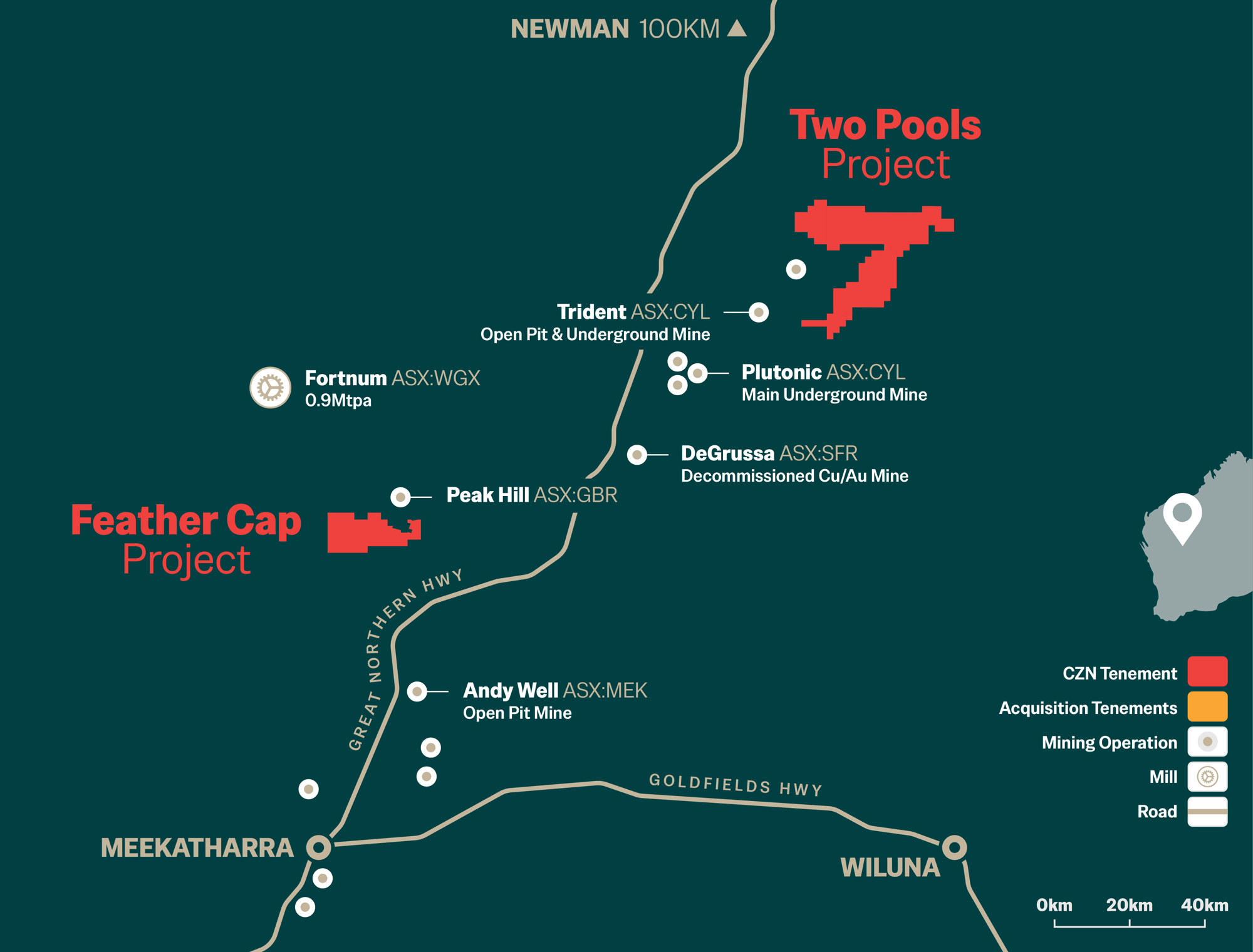
The Feather Cap Gold Project covers approximately 154km² in the Bryah-Padbury Basin, part of the Capricorn Orogen in Western Australia. The basin is a proven gold province, with the regional mining centres at Fortnum, Peak Hill, Horseshoe and Labouchere having collectively produced more than two million ounces of gold. Feather Cap sits near Westgold Resources’ Fortnum operations and adjacent to Great Boulder Resources’ Durack gold deposit.
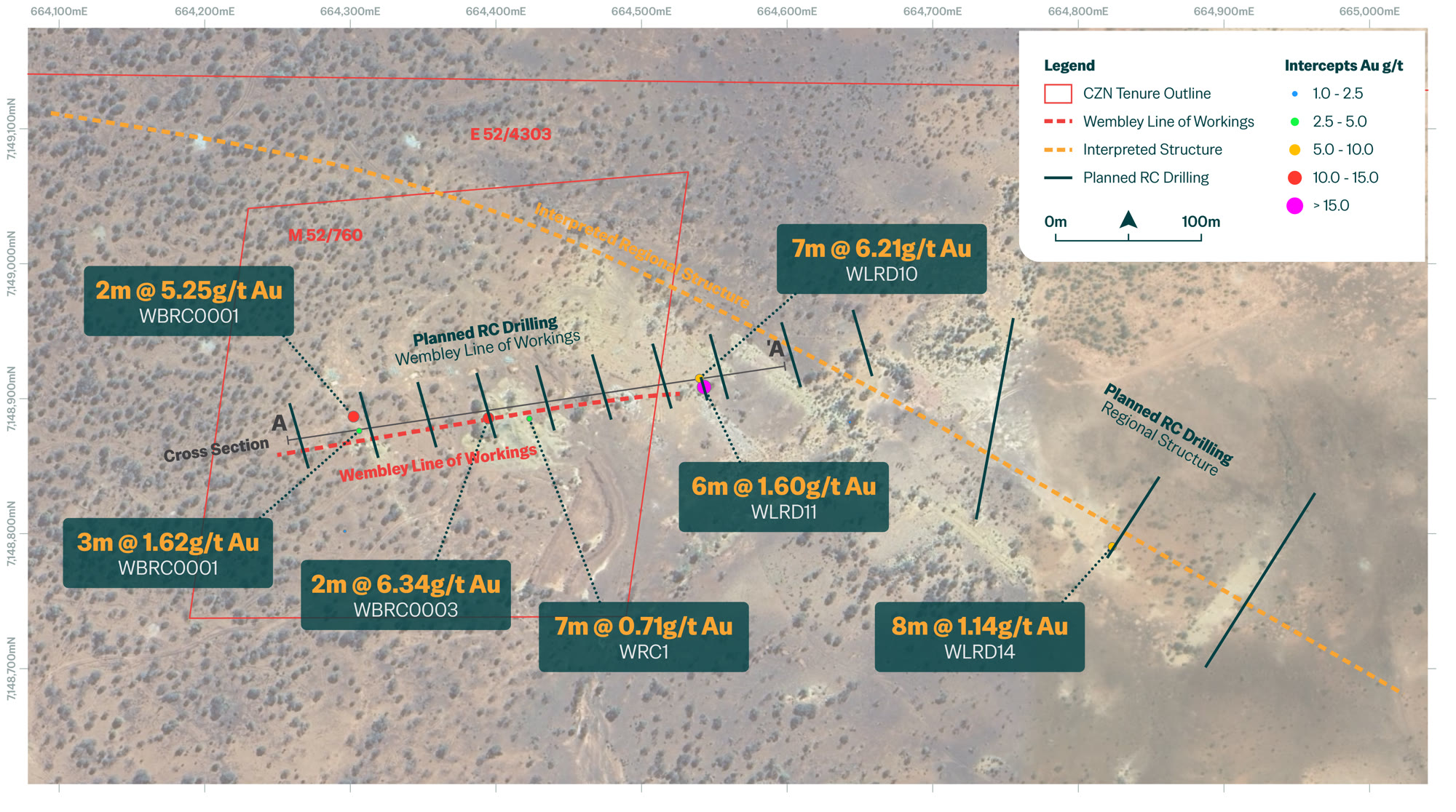
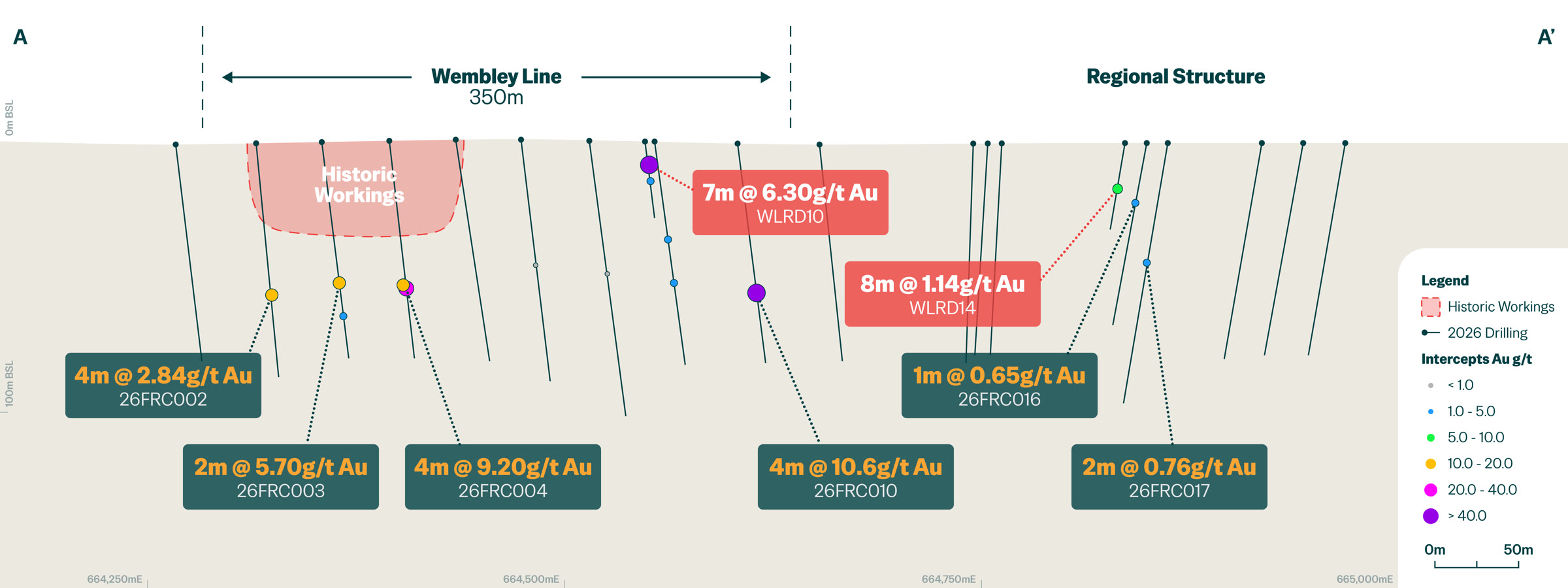
In August 2026 Corazon completed a maiden 2,000 metre, 20-hole reverse circulation program at the Wembley prospect. The results confirmed high-grade gold mineralisation beneath and along strike from the historic workings, with fourteen holes intersecting a strong high-grade zone at approximately 55 metres vertical depth.
The program returned standout intercepts including 4m @ 10.60 g/t Au from 66m (26FRC010), 4m @ 9.20 g/t Au from 65m (26FRC004) and 2m @ 5.70 g/t Au from 64m (26FRC003). The best intercept sits approximately 60 metres east of historical drilling, and the mineralised structure remains open at depth.
All intervals are reported as downhole widths. True widths are unknown.
High-Grade Confirmed at Wembley
Maiden RC drilling returned 4m @ 10.60 g/t Au from 66m (26FRC010), 4m @ 9.20 g/t Au from 65m (26FRC004) and 2m @ 5.70 g/t Au from 64m (26FRC003), reproducing the historical high-grade mineralisation and extending it along strike.
A Coherent System, Not Isolated Pods
Fourteen of twenty holes intersected a strong high-grade zone at approximately 55m vertical depth, demonstrating that the Wembley Line is a coherent, structurally controlled gold system rather than a series of isolated high-grade pods.
Proven Gold District
Located in the Bryah-Padbury Basin near Westgold’s Fortnum operations and adjacent to Great Boulder Resources’ Durack gold deposit, in a province that has produced more than two million ounces.
A Pipeline Behind the Drill Bit
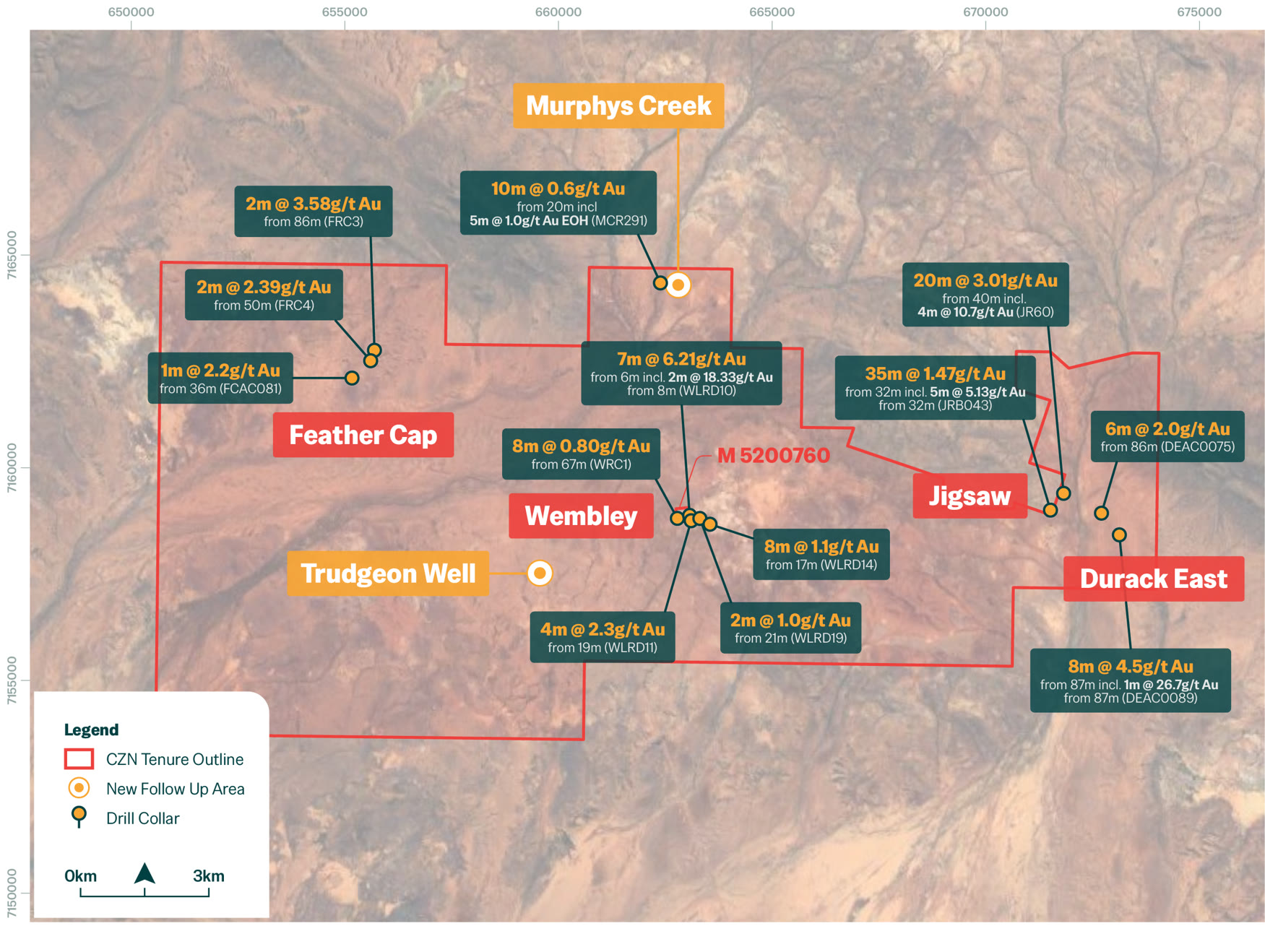
Three further targets remain to be tested. Durack East/Jigsaw carries historical intercepts including 35m @ 1.47 g/t Au from 32m including 5m @ 5.13 g/t Au from 32m (JRB043). Trudgeon Well is an untested 3.5km gold-in-lag anomaly with a peak surface sample of 760 ppb Au. Murphy’s Creek sits along strike from the Durack deposit, where no historical hole tested below 40 metres.
Exploration Strategy
The maiden program at Wembley was designed to answer one question: whether the high-grade historical intersections were isolated pods or the surface expression of a larger, structurally controlled system. The results answered it. Fourteen holes intersected a strong high-grade zone at approximately 55 metres vertical depth, the mineralisation was extended along strike, and the best intercept sits east of all historical drilling with the structure open at depth.
A further six holes tested the interpreted regional Wembley structure south of the main workings, returning anomalous gold including 2m @ 0.76 g/t Au from 55m (26FRC017) and 1m @ 0.65 g/t Au from 28m (26FRC016), which correlates with historical drill hole WLDR14 that returned 8m at 1.14 g/t Au from 17m depth and confirms the structure carries gold and warrants further work.
Corazon is planning a follow-up program to test the strike and depth extensions of the confirmed Wembley Line mineralisation, with the objective of supporting an initial Exploration Target and a potential maiden Mineral Resource Estimate.
Beyond Wembley, Durack East/Jigsaw is drill-ready, surface mapping and sampling at Trudgeon Well will rank targets within the 3.5km anomaly, and drill planning is progressing at Murphy’s Creek.
Historical production note: The former Wembley mine is reported to have produced approximately 1,050 ounces of gold from 1,510 tonnes between 1926 and 1935, an implied recovered grade of approximately 21 g/t Au. These historical production records have not been independently verified by Corazon and are not an indication of the grades likely to be returned by current or future drilling.